The Forged Will Framework
A complete model for constructing agency in a determined world.
The Three Pillars of Forged Will

Determinism
You are not an island of uncaused choice. Every thought, emotion, and action you experience is the result of prior causes—genetics, history, environment, and biology. The version of you that exists right now is your Given Self. You did not choose it, but you are responsible for navigating it.
This is not fatalism. Fatalism claims the future is already written and cannot be changed. Determinism simply means that what you do next is determined by current conditions. If you change the conditions, you change the outcome.
"The shift changes everything. When outcomes disappoint, the question shifts from 'Why didn’t I choose better?' to 'What conditions produced this result?'"
Why this matters:
End the Shame Cycle: When you understand that your struggles are caused by conditions rather than "weak character," self-blame dissolves into strategic curiosity.
Shift to Leverage: Instead of wasting energy wishing you were different, you focus on modifying the environment that shapes you.
Construct Agency: You cannot "will" yourself into a new personality, but you can systematically construct the conditions that make a new version of yourself inevitable.
Bayesian Reasoning
The Brain is a Prediction Machine Your brain does not passively perceive the world; it actively predicts it based on past experiences.
Predict: You anticipate an outcome (e.g., "Working hard yields reward").
Test: You act on that prediction.
Update: If reality contradicts the prediction (prediction error), the brain rewires its model.
Result: Agency isn't a fixed trait; it is the compounding result of reducing prediction errors over time.
Complex Systems
Small Changes, Dramatic Outcomes Human behavior emerges from complex systems where multiple factors interact in non-linear ways.
The Myth: Big results require big, heroic efforts.
The Reality: Systems are sensitive to initial conditions. A small adjustment—like moving your phone to another room—can cascade into better focus, which leads to flow states, which leads to higher satisfaction.
The Strategy: Stop looking for the "one thing" that fixes you. Start experimenting with high-leverage small changes.
The Goal: We act probabilistically, making small moves that increase the likelihood of a beneficial cascade.
SAOU Loop:
How Agency is Constructed
1. SCAN (The Assessment)
Stop before you start. Do not act on autopilot. Assess the current state of your Given Self (energy, emotion, capacity) and your Environment (constraints, resources).
The Shift: Acknowledging "I am at 20% bandwidth" is not a weakness; it is accurate data required for a successful strategy.
Agency is not a trait you have; it is a loop you run. The brain learns naturally by making predictions, testing them, and updating based on errors. The SAOU Loop makes this automatic process conscious and systematic. It replaces vague "trying harder" with specific experimentation.
2. ACT (The Prediction)
Turn vague intention into a specific hypothesis. Don't just "do your best." Take an action based on a specific prediction: "If I do X, I expect Y to happen".
The Shift: This transforms failure into information. If the outcome differs from the prediction, you haven't failed; you've discovered a prediction error.
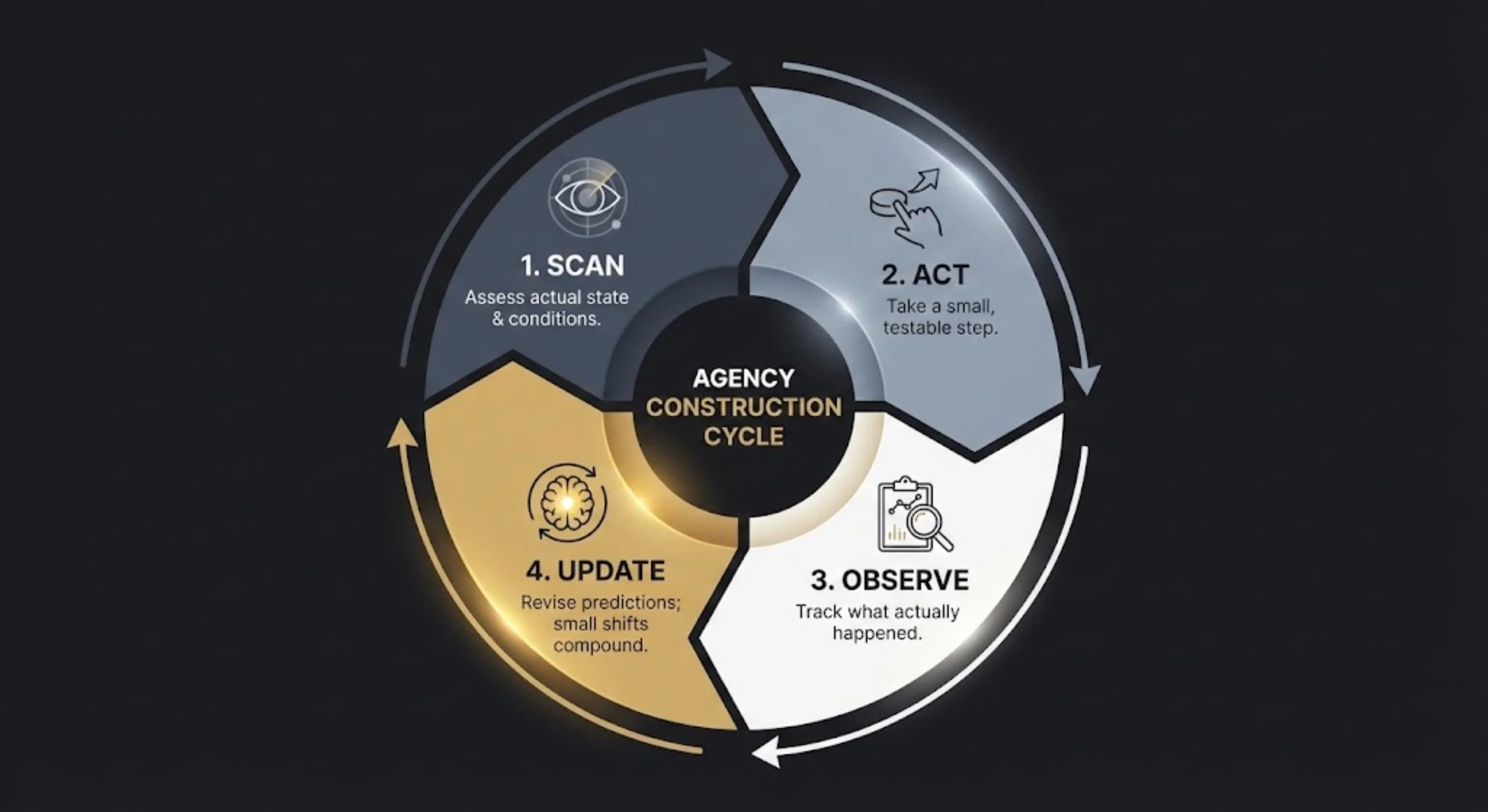
3. OBSERVE (The Data)
Watch the result, not the story. Notice what actually happened, distinct from what you hoped would happen or what you fear it means.
The Shift: Stripping away the narrative ("I'm lazy") to reveal the data ("I worked for 15 minutes before distraction occurred").
4. UPDATE (The Evolution)
Close the loop. Use the gap between your prediction (Step 2) and your observation (Step 3) to refine your model.
The Shift: You don't force yourself to be different. You update your approach based on evidence. Small updates compound into massive capability changes over time.
The Five Master Practices
Awareness
Practice

The Function: Accurate Scanning.
The Why: You cannot navigate a territory you cannot see. Most of our suffering comes from fighting what is already happening. Awareness gathers the raw data of your current state (bandwidth, emotion, constraints) before you attempt to act.
Physical
Practice

The Function: Embodied Regulation.
The Why: The body knows things the mind hasn't processed yet. Movement is not just for fitness; it is a primary feedback system. It regulates the nervous system when thinking fails and reveals capacity limits that self-narratives try to hide.
Journaling
Practice

The Function: Pattern Recognition.
The Why: Memory is a reconstruction, not a recording. We edit the past to fit our current mood. Journaling acts as a "black box" recorder, documenting actual choices and outcomes so patterns become undeniable over time.
Narrative
Reframing

The Function: Story Updates.
The Why: Your brain compulsively generates stories to explain reality ("I failed because I'm weak"). Reframing isn't positive thinking; it is the discipline of checking those stories against evidence and updating them to fit the facts.
Signal
Relationships
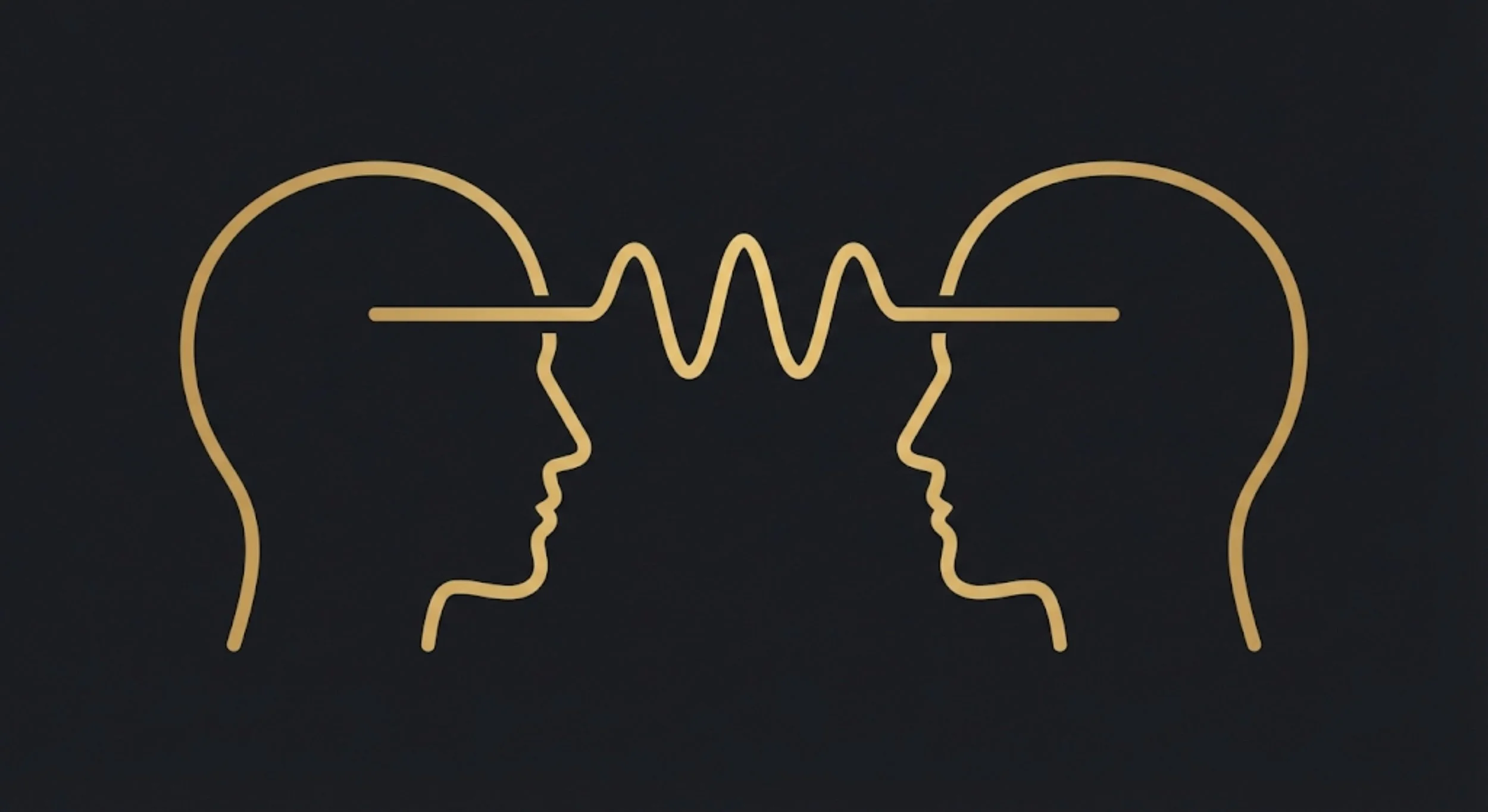
The Function: External Calibration.
The Why: You cannot see your own eyes directly. We all have blind spots that only an external perspective can reveal. A signal partner doesn't give advice; they mirror back what they observe, providing data you cannot generate alone.
Supporting Models
Given Self
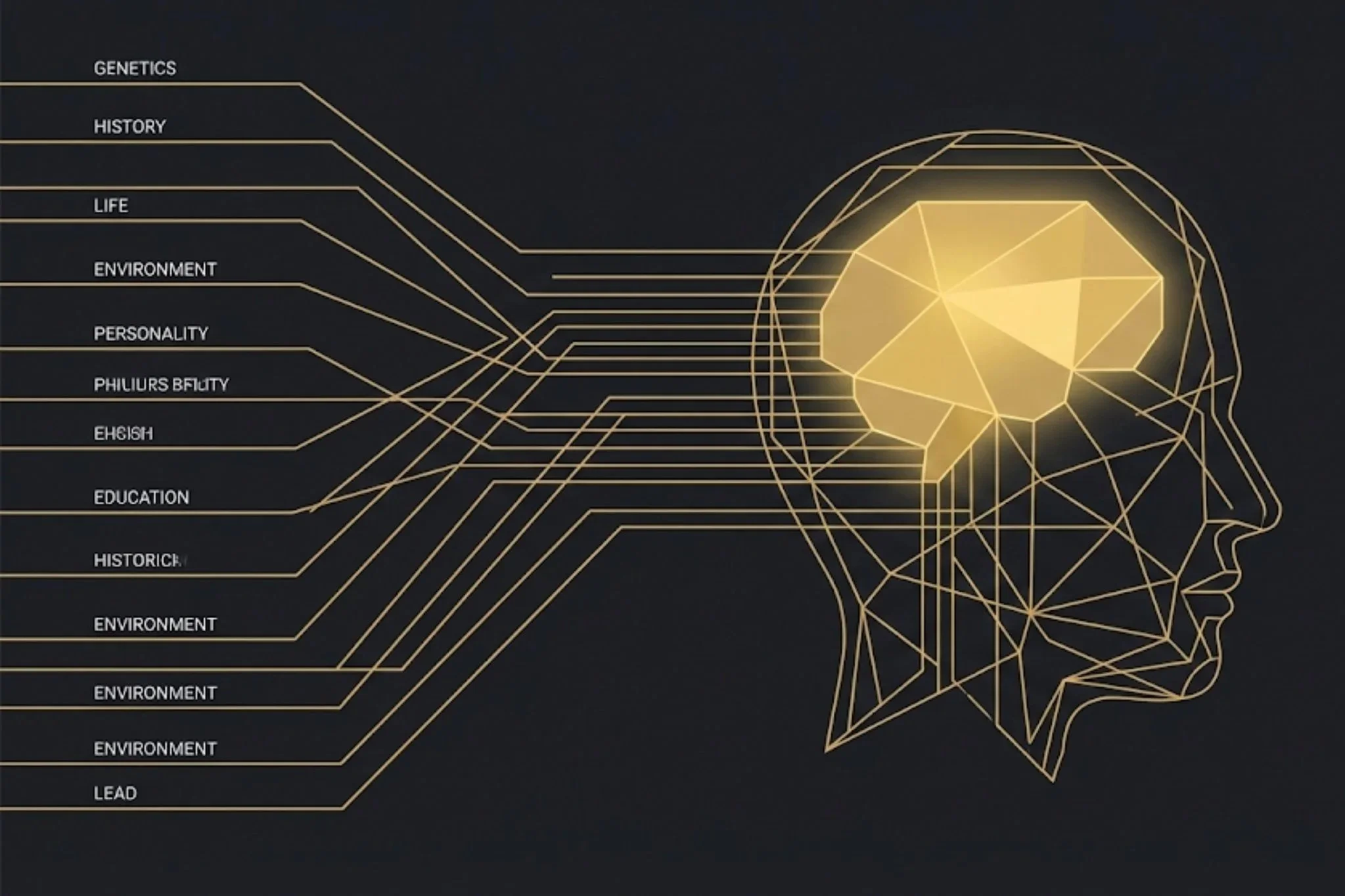
The Myth of the "Chosen Self" vs. The Reality of the "Given Self"
The Chosen Self (Myth): The idea that you are an independent operator who creates yourself through sheer willpower, separate from your history or biology. This leads to shame when you can't "choose" to be different.
The Given Self (Reality): The version of you that exists right now—your genetics, your trauma history, your current energy levels, and your automatic reactions—is the result of causes you didn't pick .
The Shift: You are not responsible for creating your Given Self, but you are responsible for stewarding it.
How SAOU Reshapes It: You cannot change your Given Self in the past, but the SAOU loop allows you to inject new experiences (causes) into the system today . Over time, these new causes reshape the Given Self of tomorrow.
Care Principle

Capacity, Accountability, Reciprocal Equity (CARE): How do we hold people accountable if free will doesn't exist? We replace 'desert' (what you deserve) with 'construction' (what you need).
The Principle: A system can only ethically demand a capacity (like self-regulation or productivity) if it has first facilitated the development of that capacity.
The Architecture: You cannot demand a roof without building the pillars. If you demand high performance (Accountability) but provide low support (Capacity), the structure collapses.
The Application: Whether leading a team, raising a child, or managing yourself—focus on building the structural capacity to do the work before punishing the failure to do it.
Bandwidth

Capacity is a Constraint, Not a Choice: Most agency failures are not failures of discipline; they are failures of bandwidth recognition.
The Reality: Your ability to access your skills fluctuates based on fatigue, stress, and environment.
Green Zone (80%+): High capacity. You can learn new things and handle complexity.
Yellow Zone (40-80%): Maintenance mode. Stick to known routines.
Red Zone (<40%): Survival mode. Protect the basics; do not attempt growth.
The Practice: Stop asking "What do I want to get done?" and start asking "What does my bandwidth allow?" Adjusting your expectations to match your gauge prevents the shame spiral of constant failure.
The Map Is Not The Territory
You now understand the mechanics of Constructed Agency. But understanding does not build capacity. Agency is not something you read about; it is something you forge through the accumulation of small, specific acts.
You have the principles. It is time to begin the practice.